The smartest money you can spend on a used car is paid before you sign the title, not after. A mobile pre-purchase inspection from an independent mechanic catches what dealer 'multi-point inspections' and Carfax reports routinely miss — and gives you a written record you can use to walk away, renegotiate the price, or buy with full confidence.
What a pre-purchase inspection actually is
A pre-purchase inspection (PPI) is a structured, top-to-bottom evaluation of a used vehicle performed by an independent mechanic who has no financial interest in the sale. Its job is to answer two questions: is this car safe and mechanically sound today, and what does it look like is coming next — repairs, maintenance, or hidden problems the seller may not have disclosed.
A proper PPI is not a five-minute walkaround, and it is not the same thing as a dealer's free 'multi-point inspection.' It takes about 90 minutes on a standard car, uses real measurement tools instead of clipboard checkmarks, and ends with a written report and photos you keep — not a marketing handout.
What we check on a pre-purchase inspection
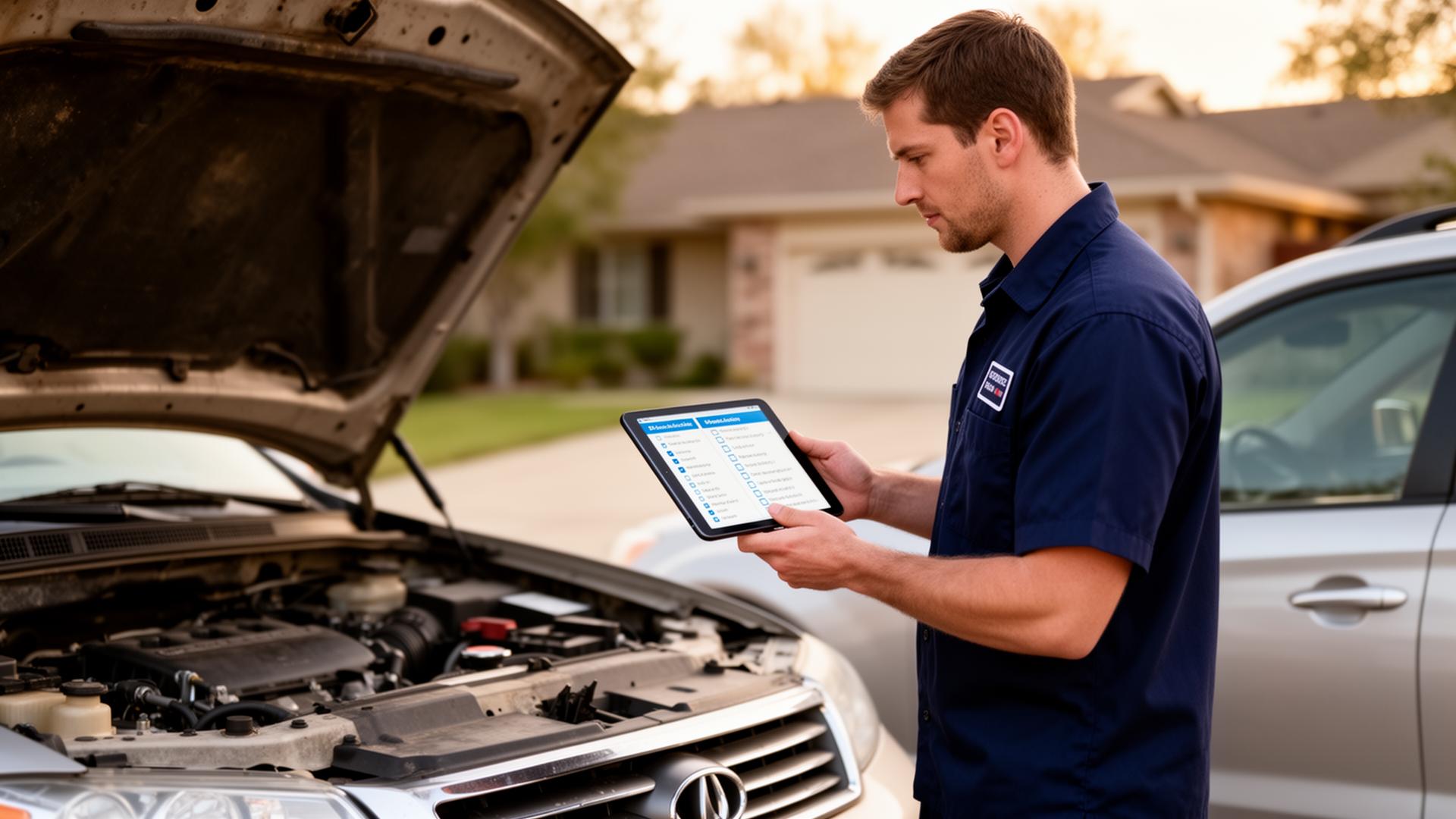
We inspect the systems that cost real money to fix. The walkaround starts with body and frame condition, then moves through the drivetrain and underbody. Every visit ends with a road test and a full diagnostic scan.
- Engine: oil and coolant condition, visible leaks, belt and hose condition, mounts, smoke at idle and under load
- Transmission: fluid color and smell where checkable, shift quality, torque-converter behavior, stored adaptation data
- Suspension and steering: bushings, ball joints, tie rods, sway-bar links, shock and strut condition, wheel-bearing noise
- Brakes: pad thickness, rotor thickness and surface condition, caliper slide condition, brake-fluid moisture content
- Cooling system: radiator, water pump weep, thermostat behavior, coolant pH and condition
- Drivetrain: CV axles and boots, driveshaft, differential and transfer-case seals on AWD/4WD vehicles
- Electrical: battery state of health, alternator output, starter draw, wiring and connector condition
- Tires and wheels: tread depth across the width, age date code, sidewall damage, bent or curbed wheels
- Full OBD-II plus manufacturer-specific scan — including modules a generic scanner can't reach on BMW, Mercedes, Audi, Volvo, and Tesla
- Road test on local streets and highway speeds, noting any drift, vibration, or noise under load and braking
What Carfax, AutoCheck, and dealer inspections miss
A clean Carfax or AutoCheck report means no reported accident, no reported title issue, and no reported odometer rollback. It does not mean the engine is healthy, the timing chain isn't stretched, a head gasket isn't seeping, the transmission isn't slipping, or that a previous owner didn't repair collision damage out of pocket without ever filing an insurance claim. We see all of those things regularly on cars with picture-perfect history reports.
Vehicle history services only know what was reported to them. They don't know about the leaking valve cover, the cracked engine mount, the soft brake pedal, or the cluster of pending codes the seller cleared before posting the ad. A mechanic with the car in front of them does.
Dealer 'multi-point inspections' are a different problem: a built-in conflict of interest. The dealer is selling you the car. They are unlikely to volunteer that the rear differential is whining or that the rear pads are at three millimeters when those facts cost them money. Our inspection works for you, not the seller.
The three outcomes of a pre-purchase inspection — and why each is a win
Every PPI ends in one of three places. Each one leaves you better off than buying blind.
- The car checks out — you buy with confidence and a written baseline of its current condition, which you can hand to your next mechanic to spot changes over time.
- The car has issues you can live with — you take the inspection report back to the seller and renegotiate the price to cover the upcoming repairs. Sellers tend to take a documented report seriously in a way they don't take your gut feeling seriously.
- The car has serious problems — bent frame, salvaged airbag, failing transmission, oil-burning engine — and you walk away. The inspection paid for itself many times over before you ever signed.
Why a mobile PPI works better than dragging the car to a shop
Most private sellers and a lot of small lots will not let you take an unfamiliar car off-site for an inspection. They do not know you, they are worried about the car coming back damaged, and they are not going to hand you the keys to drive across town. That is a reasonable position from their side — and it is also exactly how a lot of buyers end up skipping the inspection altogether.
A mobile PPI removes that objection. We come to the seller's driveway, the dealer's lot, the storage unit, or the parking lot where you've arranged to meet. We do the inspection on the spot, you get the report before you sign anything, and nobody is haggling about who gets the keys.
It also gives you something most shop inspections do not: an honest conversation in real time. If we find something on the road test, we can talk through it with you before the seller has time to deflect.
Vehicles and brands we inspect
We inspect everything from daily-driver Hondas and Toyotas to European platforms that need brand-specific scan tools to read properly. We are especially busy with used Honda, Toyota, Subaru, Ford, Chevy, BMW, Mercedes, Audi, and Tesla pre-purchase inspections across Raleigh, Durham, Cary, Chapel Hill, Apex, Wake Forest, Garner, Fuquay-Varina, Holly Springs, Clayton, Knightdale, Morrisville, Wendell, and Rolesville.
Common questions before you book a PPI
- Where do you go? Anywhere the car is — private driveways, small lots, storage facilities, and most dealerships across the Triangle.
- How long does the inspection take? About 90 minutes on-site for a standard car. European platforms and EVs run longer because their scan coverage is deeper.
- How fast do I get the report? Same day, by text or email, with photos and a summary of findings.
- Will the dealer let you do it? In our experience, most will. We're happy to call the dealer ahead of time if you give us their name and the stock number.
- What if I'm out of town? Buyers regularly hire us for cars they've never seen — we send written reports and photos before they fly in or arrange shipping.
- Should I get a PPI on a less expensive used car? Especially then. The math gets worse, not better, when you have a smaller budget to absorb a hidden repair.