The check engine light is one of the most misunderstood warnings on the dashboard. Here's how to tell the difference between 'keep driving and book a diagnostic this week' and 'pull over now' — and why a code from a parts-store scanner is the beginning of the diagnosis, not the end of it.
What the light actually means
The check engine light — sometimes called the malfunction indicator lamp, or MIL — is the car's way of telling you the engine control module has logged a fault somewhere in the powertrain or emissions system. It does not, on its own, tell you how serious the problem is. That part comes from the code, the live data behind it, and the symptoms you're feeling from the driver's seat.
The light can come on for something as minor as a loose gas cap or as serious as a misfire that's destroying the catalytic converter in real time. The first useful question is always: is the light steady, or is it flashing?
Steady light vs. flashing light
A steady check engine light means the car's computer has logged a fault and wants it looked at, but the car can usually be driven safely to your next service appointment. Schedule a diagnostic in the next few days; in the meantime, drive normally and pay attention to anything new the car is doing.
A flashing or blinking check engine light is different. It means the engine is misfiring badly enough that unburned fuel is being dumped into the exhaust, which can overheat and damage the catalytic converter in a short distance. If the light is flashing, ease off the highway, get the car somewhere safe, and call us before driving any further.
What a code reader actually tells you
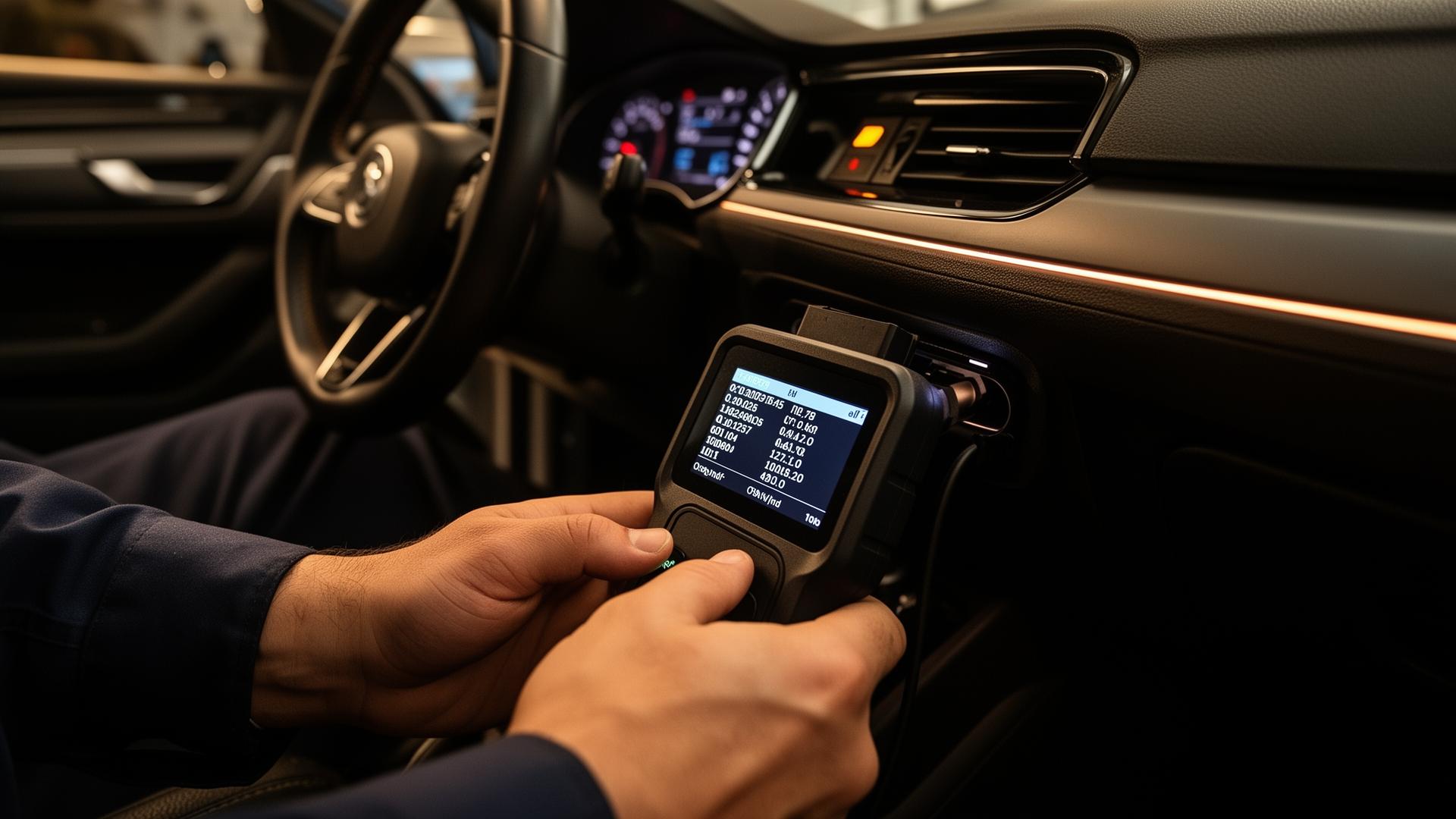
Any auto-parts store will plug in a basic scanner for free and tell you something like 'P0420 — catalyst efficiency below threshold (bank 1).' That is a clue, not a diagnosis. The same code can be triggered by a tired catalytic converter, a failing upstream or downstream oxygen sensor, an exhaust leak in front of the sensor, an ignition misfire, a vacuum leak that's lean-shifting the fuel trim, or even a bad tank of fuel.
Replacing parts based on a code alone is how people end up paying for an expensive catalytic converter when the real problem was an upstream sensor — or vice versa. The code points you at a system; a proper diagnostic figures out which component inside that system is actually misbehaving.
It's also worth knowing that a generic OBD-II scanner reads generic emissions codes. Manufacturer-specific codes — common on BMW, Mercedes, Audi, Volvo, Volkswagen, and Tesla — often require a brand-specific scan tool to pull. A parts-store scanner can completely miss a chassis or transmission code that the manufacturer scanner pulls up immediately.
How we actually diagnose a check engine light
Our mobile diagnostic visit is built around answering one question: what is the real root cause of this code, before any parts get ordered?
- Pull stored, pending, and history codes from every module — engine, transmission, ABS, body, and on European cars, all the chassis modules a generic scanner can't see
- Read freeze-frame data captured at the moment the fault was logged — RPM, load, fuel trim, coolant temp, vehicle speed
- Watch live data with the engine running: short- and long-term fuel trims, sensor voltages, misfire counters per cylinder
- Inspect the affected system physically — wiring, connectors, vacuum lines, intake plumbing, exhaust upstream of the sensor
- Smoke-test for vacuum and EVAP leaks when the codes point that way
- Compare what we're seeing against known-good values for that engine, not just generic specs
- Verify the fix after repair — clear the codes, drive the readiness monitors, and confirm the light stays off
Common check engine light triggers we see
- Oxygen sensors and air-fuel ratio sensors (P0130 family, P0171/P0174 lean codes)
- Evaporative emissions leaks — often as simple as a loose or failed gas cap (P0440, P0442, P0455, P0456)
- Misfires from worn spark plugs, failing coils, dirty fuel injectors, or low compression (P0300–P0312)
- Mass airflow sensor contamination, especially common after an aftermarket air filter is over-oiled
- Catalytic converter efficiency faults downstream of the actual cause (P0420, P0430)
- Thermostat stuck open or coolant temperature sensor drift, which can also hurt fuel economy (P0128)
- EGR system faults on cars that still use one — sticking valves, blocked passages
- Turbocharger boost-pressure or wastegate faults on modern turbo platforms
- VVT and timing-related codes on Toyota, Honda, BMW, and Hyundai/Kia engines
Can I just clear the light myself?
Technically, yes — many parts-store scanners will clear codes. Practically, that's almost always the wrong move. Clearing the code erases the stored fault, the freeze-frame data, and the readiness monitors the next emissions check needs. The light will come back as soon as the fault recurs, and you've just thrown away the most useful information your mechanic had to work with.
If a tech recommends clearing codes, it should happen after the diagnosis, not before. Clearing first is how a repair turns into a guessing game.
When to stop driving and call right away
- Check engine light is flashing
- Car is shaking, losing power, or running noticeably rough
- You smell raw fuel or see steam or smoke from under the hood
- Temperature gauge is climbing toward the red
- Oil pressure or battery warning lights are on along with the check engine light
- A loud knock, ticking, or grinding noise has started
- The car suddenly went into a reduced-power 'limp' mode
Where we work
We diagnose check engine lights at your home or office across Raleigh, Durham, Cary, Chapel Hill, Apex, Wake Forest, Garner, Fuquay-Varina, Holly Springs, Clayton, Knightdale, Morrisville, Wendell, and Rolesville. If the car is drivable, you don't have to be — you can leave the keys and we'll text the findings.